Warehouse humidity control protects inventory, not just comfort. A storage building can look fine during the day shift and still be exposing goods to seasonal RH swings, damp cartons, softened labels, mold risk, rust on metal parts, condensation on cold racks, or musty odors that show up after loading-dock activity.
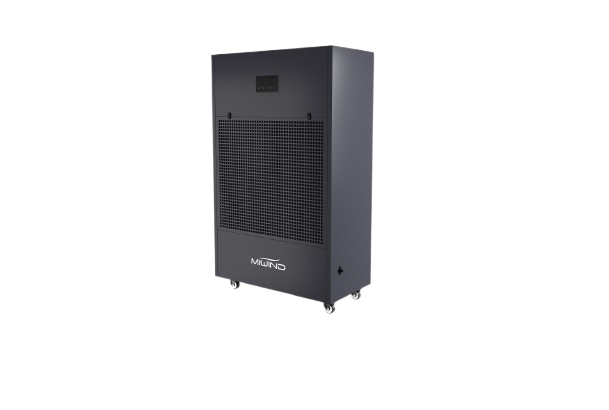
This guide is written for warehouse managers, logistics operators, facility engineers, QA teams, and distributors who advise storage customers on moisture issues. MIWIND discusses solutions, industrial dehumidifier applications, and the industrial dehumidifier series through Contact Us once site conditions are on the table.
A quick note before diving in: there's no single RH number that fits every warehouse, no guaranteed mold or rust prevention, and no universal energy-saving percentage that applies across different buildings and goods. What follows is a practical way to gather the right site data before anyone talks equipment.
Why Humidity Control Is an Inventory Issue
Inventory risk shows up in more places than damp air
Moisture affects cartons, labels, powders, metal parts, fabrics, wood, electronics packaging, spare parts, and palletized goods differently. Often the first sign isn't a humidity alarm — it's a softened carton corner, a musty smell drifting down an aisle, a rust bloom on a shelf bracket, or a warped label that won't scan.
Condair's warehousing and logistics page, Dantherm's warehouse page, and Munters' warehouse storage page are worth reading as market references — they frame humidity control around storage conditions and material risk rather than blanket claims. They're not MIWIND performance guarantees, just useful context.
Moisture problems hide in specific zones, not the whole building
One aisle can stay perfectly stable while the next one — near a dock door, an exterior wall, a roof leak, or a dead-air corner — has a real problem. This is why humidity planning works better when it's organized by zone, by goods stored, and by the season or symptom that triggered concern in the first place.
Common Moisture Sources in Warehouses
Loading doors and infiltration
Every time a loading door opens, outdoor air comes in. How much that matters depends on local climate, how long the door stays open, forklift traffic patterns, building pressure, and whether goods sit near the opening waiting to move. There's also a less obvious cause: if exhaust fans or process ventilation pull the building slightly negative, humid air can seep in through gaps even with doors shut.
Before requesting equipment, it helps to describe door count, door size, and the daily traffic pattern around peak loading hours. Once the team understands where moisture is actually entering, industrial dehumidifier sizing becomes a much more accurate conversation.
Packaging, goods, and seasonal RH peaks
Sometimes the moisture arrives with the goods themselves — wet pallets, damp cartons fresh off a production line, washed containers, or inventory transferred from a different climate zone. Seasonal RH peaks compound this: a warehouse that runs fine most of the year can turn problematic during a rainy stretch. The right target condition depends entirely on what's being stored, which is why industrial humidity control RH target planning should come before anyone commits to a mold-risk, corrosion, or condensation-control goal.
Airflow, cold spots, and condensation
Circulation matters as much as average humidity. Dead corners, uninsulated walls, roof areas, or zones next to chilled equipment can sweat locally even when the building's overall RH reading looks acceptable. The EPA's mold moisture-control chapter covers this well, with a strong emphasis on condensation, wet materials, and drying time rather than just RH percentages.
When the visible problem is sweating surfaces, wet concrete, fog near a dock, or dripping racks — rather than general dampness — preventing condensation in a warehouse is the more relevant starting point.

Monitoring Before Equipment Selection
Measure first, guess later
Place temperature and RH sensors in representative storage zones and any known trouble spots. Note when peaks actually happen — early morning, overnight, rainy days, loading windows, right after a washdown, or during a production transfer. This baseline is what keeps a dehumidifier from being sized off one lucky (or unlucky) reading.
Worth tracking:
- Current RH range and the seasonal peak RH.
- Temperature range and where the cold surfaces are.
- Which goods are affected and what symptoms show up.
- Door-open schedule and traffic peaks.
- Ventilation, exhaust, fresh air, and any pressure symptoms.
- Existing fans, HVAC, dehumidifiers, or drainage already in place.
Turn monitoring into a decision, not just a log
Data only helps if it points somewhere. RH spiking during loading? Look at doors and traffic. Condensation forming on cold surfaces? Check dew point and insulation. Cartons softening across the whole floor? That's a total moisture-load and dehumidifier-capacity question. Capacity labels alone won't answer any of this — dehumidifier capacity ratings explained is worth reading before comparing L/day or pints/day figures across supplier spec sheets.
RFQ Checklist for MIWIND Review
When reaching out to MIWIND, it speeds things up to have on hand:
- Warehouse length, width, height, and general layout.
- Goods or packaging stored, especially anything moisture-sensitive.
- Current RH range, seasonal peak RH, and a target condition if one exists.
- Temperature range, cold spots, and where condensation has been seen.
- Loading door frequency, open-time, and traffic pattern.
- Visible symptoms — mold, rust, condensation, carton softening, label damage, odor, wet floors.
- Ventilation, fresh-air, exhaust, or pressure notes, along with air circulation observations.
- Photos, drawings, sensor logs, and anything already tried.
Whatever's missing from that list is usually the first thing worth clarifying before equipment gets discussed. A tight warehouse humidity control brief keeps the conversation grounded in actual site data instead of guesswork.
It also helps to have one person own the RH logs, photos, and door-traffic notes. When those records get scattered across operations, QA, and maintenance separately, projects tend to drift back into guessing.
FAQ
What is warehouse humidity control?
It's the ongoing process of managing RH, moisture sources, airflow, and temperature — backed by monitoring — so stored goods and packaging face less humidity-related risk over time.
Is there a single RH target that works for every warehouse?
No. It depends on what's stored — packaging type, metal content, mold sensitivity — plus temperature, season, and the buyer's own storage specs.
Will a dehumidifier guarantee no mold or rust?
No single piece of equipment can promise that. Mold and rust risk depend on moisture sources, materials, temperature, how long goods sit in storage, and ongoing monitoring — equipment selection is one part of a larger system.
What should be collected before choosing equipment?
Building dimensions, goods stored, RH and temperature history, visible symptoms, door traffic patterns, ventilation notes, and any monitoring records already gathered.
Next Step: Request a Warehouse Humidity Plan
Bring the checklist above to MIWIND's team and the conversation moves faster — clear warehouse humidity control data means less back-and-forth before landing on the right solution discussion.
If possible, get operations, QA, and maintenance in the same room for this review. Symptoms and records that stay siloed across departments are exactly what slow projects down.