Inline fan low airflow troubleshooting follows a disciplined sequence after installation: confirm the intended fan duty, review the safe scope of any inspection, document fan direction, check for restrictions in the duct path, compare measured static pressure against the design duty point, verify inlet and outlet conditions, and then decide whether cleaning, adjustment, further measurement, or fan re-selection is the right next step.
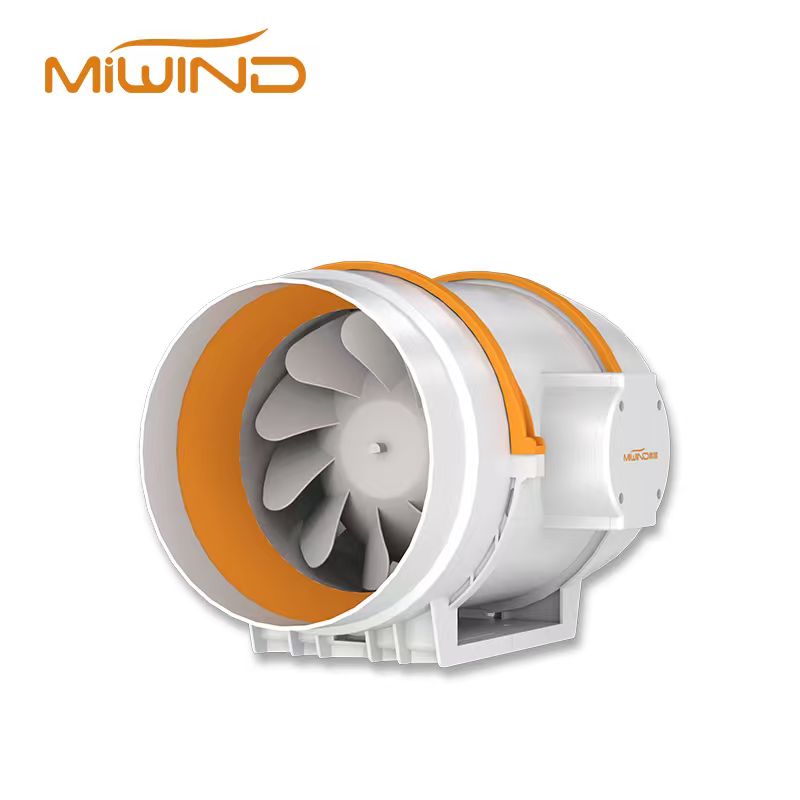
This post-purchase guide serves OEM support teams, distributors, MEP engineers, installers, facility maintenance teams, and workshop or kitchen managers who need to explain why an installed inline fan or duct booster is underperforming. MIWIND offers inline fan troubleshooting support, technical review of the MIWIND duct fan series, access to technical resources for ducted airflow projects, and fan brochures and support downloads once the site evidence has been gathered.
Use this guide to separate genuine installation errors, duct restrictions, system effects, control issues, and make-up-air shortfalls from a true fan selection problem. Model-specific CFM, static pressure, fan curve, sound, and RPM values still require current MIWIND product documentation before any performance claim is made.
Why Installed Airflow Can Be Lower Than the Catalog Rating
A published fan rating reflects performance under a defined test condition. A jobsite rarely matches that condition exactly — duct length, elbow count, filter loading, grille resistance, damper position, and reducer geometry all add resistance that a catalog figure does not capture. A low-flow complaint is therefore frequently a system resistance question before it is a product defect question.
Independent fan-curve education, such as HVAC School's fan laws reference, is useful background for understanding how airflow, speed, static pressure, and power interact along a fan curve. Treat this as engineering context, not as a substitute for verifying a specific MIWIND model against its own published curve.
For related diagnostic context, review inline duct fan static pressure basics and how to read an inline fan curve. This guide stays focused on the sequence to follow once a fan is already installed and airflow is reported as low.
Check Fan Direction, Orientation, and Speed Setting
Start with evidence the support team can verify visually. Request photos of the fan label, the airflow direction arrow, the inlet side, the outlet side, the duct connections, the controller, and the final mounted orientation. A short video showing whether the fan is running, whether vibration is present, and whether the airflow path looks reversed or obstructed speeds up diagnosis considerably.
This section is not a wiring guide. Document the installation and bring in a qualified electrician or commissioning technician whenever electrical, control, or safety questions come up.
CCOHS fan guidance reinforces a useful principle: a fan performs as part of a ventilation system, not as an isolated device. That framing helps MIWIND support teams request project evidence before recommending a replacement unit.
Inspect Duct Restrictions, Filters, Dampers, Grilles, and Leaks
Dirty or clogged components
A loaded filter, blocked grille, dirty screen, clogged inlet, closed damper, stuck backdraft flap, or obstructed outlet can all choke airflow even when the fan itself runs correctly. The motor may be healthy while the air path is simply not open.
Ask the buyer to report current condition rather than to modify the design. Filters, dampers, hoods, guards, and fire-rated components frequently serve a safety, code, or process function, so any adjustment should go through qualified personnel.
Disconnected joints, reducers, and blocked inlets
Retrofit installations commonly involve flex duct, reducers, taped joints, tight ceiling cavities, sharp bends, or a grille mounted too close to the fan inlet. A leaking joint can pull air from the wrong location entirely, and a partially blocked inlet raises both noise and resistance at the same time.
CCOHS ventilation troubleshooting guidance supports a practical habit: identify the symptom, inspect each system component in sequence, and confirm actual field conditions rather than diagnosing from fan performance alone.
Compare Static Pressure With the Fan Curve Duty Point
When system resistance runs higher than the buyer expected, installed airflow can fall well below the rating they remember from the spec sheet — this is the recurring "installed CFM lower than rating" complaint.
For support, request:
- Target airflow, if an engineer specified one.
- Estimated static pressure, if measured.
- Duct diameter, length, elbow count, reducers, filter type, grille type, damper position, and discharge fitting.
- The fan model or SKU, if known.
- Application type: supply, exhaust, recirculation, cabinet ventilation, or fresh-air support.
Do not confirm that a specific MIWIND model meets a stated duty point unless current product documentation supports it. Refer buyers to the MIWIND duct fan series when the installed duty appears to require re-selection across inline fans, compact duct runs, cabinet ventilation, or fresh-air applications.
Look for Inlet and Outlet System Effects
System effects occur when the actual inlet or outlet condition differs from the fan's rated test condition. A tight elbow immediately upstream of the fan, an abrupt transition, a restricted outlet, insufficient discharge clearance, or a cramped plenum can each cut into usable airflow, sometimes significantly.
For MIWIND support, the practical step is to request photos and a simple sketch showing fan position, nearby fittings, the full duct route, and the discharge location. This visual evidence often reveals a system effect that no amount of remote troubleshooting can catch otherwise.
Check Make-Up Air as One Possible Low-Flow Cause
Every exhaust fan needs a matching supply of replacement air. If a fan is pulling from a tight room, sealed cabinet, closed closet, restaurant, workshop, or utility space with no planned intake path, airflow can feel weak even though the fan is functioning normally. Doors pulling inward, whistling grilles, and higher-than-expected running noise are common side effects of this specific cause.
Make-up air is one branch among several possible causes covered in this guide. Where pressure symptoms clearly dominate, review make-up air and exhaust balance. Where long duct resistance is the likelier cause, review sizing inline duct fans for long duct runs and inline duct fan placement and straight duct.
When Cleaning, Adjustment, or Fan Re-Selection May Be Needed
Once the basic checks are complete, the right next step could be maintenance, commissioning, further measurement, control review, duct correction, or fan re-selection. The decision should follow the evidence collected:
| Finding | Possible next step |
|---|---|
| Fan installed backwards or unclear airflow direction | Have a qualified technician verify orientation and wiring safely. |
| Dirty filters, screens, grilles, or ducts | Schedule cleaning or maintenance according to project requirements. |
| Closed damper or blocked discharge | Confirm the damper or outlet's intended purpose before any adjustment. |
| High static pressure or long duct route | Re-check the duty point against available product data. |
| Controller appears set to low speed | Verify the intended control sequence with the installer or project team. |
| No make-up air path for exhaust | Review the replacement-air route before selecting a larger fan. |
Gather documentation through technical resources for ducted airflow projects and fan brochures and support downloads, then reach out via inline fan troubleshooting support once photos, symptoms, and project details are in hand.
FAQ
Why is my inline duct fan not moving enough air?
Common causes include reversed orientation, a low speed setting, duct restrictions, dirty filters, closed dampers, leaking joints, blocked grilles, high static pressure, poor inlet or outlet conditions, or a missing make-up air path.
Should I immediately replace the fan?
Not necessarily. Document the installation, duct route, restrictions, controls, and application first. Re-selection only makes sense once the actual duty point and site conditions are properly understood.
Can MIWIND guarantee installed airflow from this article?
Installed airflow depends on the full duct system, site conditions, product documentation, installation quality, ongoing maintenance, control settings, and the measurement method used.
Next Step: Get Troubleshooting Support
Contact inline fan troubleshooting support with the installed model or SKU, fan orientation photos, duct diameter, duct length, elbow count, reducers, filter and damper condition, controller setting, room or application type, make-up air path, observed symptoms, measured airflow if available, and target airflow if an engineer specified one.