High RH After Cooling: How to Review the Latent Load
Trace high RH after cooling to ventilation, leakage, runtime, process moisture and controls before considering dedicated dehumidification.
If a warehouse or workshop reaches its temperature setpoint but remains above its humidity target, investigate the moisture load and system controls before adding equipment. The cause may include outdoor air, leakage, process moisture, airflow or insufficient runtime for moisture removal.
Temperature and humidity describe different parts of the room condition. An air-conditioning coil may remove moisture when it operates below the air's dew point and condensate drains from the coil, but the result depends on coil conditions, airflow, controls and runtime. A temperature reading alone does not show whether the moisture load is being controlled.
MIWIND should be discussed only after that distinction is clear. A dehumidifier inquiry is not a shortcut around HVAC design; it is the next question when the AC can hold temperature but not the humidity target.
Why RH Stays High After Temperature Is Controlled
Sensible Cooling vs Moisture Removal
An air conditioner removes heat. That is sensible cooling. It may also remove some moisture when the coil runs long enough and the coil surface is cold enough for condensation to form. But if the room has a persistent moisture source, the AC may never get enough latent runtime to move the RH where the buyer wants it.
That is why this HVAC humidity control industrial space question should not begin with "How big is the unit?" It should begin with "What is adding moisture, how often does the system run, and what does the room actually need?" A warehouse or workshop can be cool and still carry a large moisture load from outdoor air, open doors, wet goods, process evaporation, or insufficient coil runtime.
Short cycling can limit moisture-removal runtime, while a high outdoor-air or process load can exceed the system's capacity. These are possibilities to check, not a diagnosis from room temperature alone. Review equipment operation, controls, airflow and measured humidity trends with the HVAC contractor.
Short Cycling, Airflow, and Coil Runtime
Short cycling is one of the quiet ways RH problems survive. The unit may hit the temperature setpoint fast, then shut off before enough latent removal happens. Airflow matters too. If supply air does not reach the wettest zone, or if return air is short-circuiting back to the coil, the equipment can look busy while the room condition hardly moves.
Some HVAC systems use control strategies that separate temperature control from moisture removal. Have the designer check the installed system and its approved sequence before changing setpoints or adding dehumidification. A dedicated dehumidifier is one option only after the remaining moisture load and operating conditions are understood.
Industrial Humidity Diagnostic Checklist
Ventilation Load, Air Leakage, and Open Doors
Before recommending equipment, check the load sources in this order:
- Outside air intake or make-up air that brings in moist air.
- Dock doors, personnel doors, roll-up doors, and traffic frequency.
- Envelope leakage around walls, roof transitions, penetrations, and service openings.
- Exhaust fans that may pull humid outdoor air into the building.
- Pressure imbalance that makes the room inhale more outdoor air than expected.
If the building is near an industrial entry, a loading zone, or a warm-season storage area, the RH problem may have very little to do with the thermostat. The room can be cool because the AC is working while the moisture load keeps entering from the outside or from neighboring spaces. In that case, sealing, air balance, or ventilation changes may help, but the project may still need dedicated moisture removal.
Process Moisture and Storage Conditions
Many workshops and warehouses create moisture themselves. Wet parts, washdown, cleaning cycles, open tanks, curing, drying, condensation on cool surfaces, and stored pallets that were loaded in humid weather can all raise RH. If the moisture source is part of the operation, a larger AC alone may not solve it.
That is why the check should include:
- What work happens in the room?
- Is water added on purpose?
- Are items entering the space already damp?
- Are there cold surfaces or morning condensation?
- Is the problem steady, or does it spike after a shift change, cleaning cycle, or door opening?
The difference matters because the corrective action changes. Ventilation load may call for air sealing or balance. Process moisture may call for housekeeping or workflow changes. Persistent RH after those fixes can point to dedicated dehumidification.

When to Discuss Dedicated Dehumidification
If the space temperature is acceptable but RH remains high, dedicated dehumidification deserves a separate review. That is especially true when the room has one or more of these traits: frequent door openings, outdoor air leakage, process moisture, storage risk, or a need for tighter control than the AC can supply on its own.
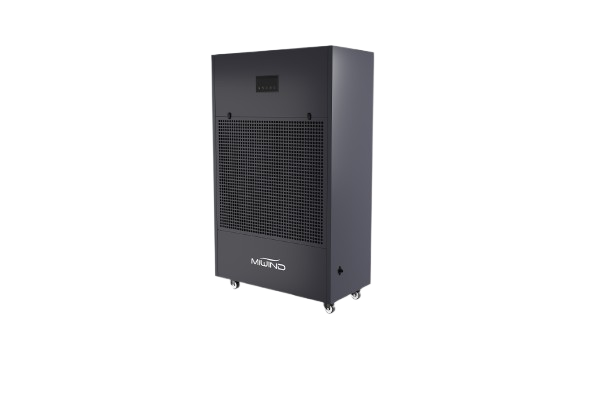
The goal is not to declare that HVAC has failed. The goal is to identify whether the remaining problem is latent load. If the answer is yes, MIWIND's industrial dehumidifier route becomes relevant, along with the broader solutions context and industrial dehumidifier series documents. The buyer still needs project data, but the conversation can move from "why is the room hot?" to "what is still adding moisture?"
For an HVAC humidity control industrial space inquiry, the most useful MIWIND brief is short and factual. Share the floor area, ceiling height, current RH, target RH, AC runtime behavior, door traffic, outside air or exhaust detail, and any process moisture sources. That is enough for a first review without turning the discussion into guesswork.
What to Send MIWIND
Send these items before asking for a recommendation:
- Space type: warehouse, workshop, storage room, or production area.
- Floor area and ceiling height.
- Current RH and temperature.
- Target RH or buyer-side humidity requirement.
- AC runtime pattern and whether the unit short cycles.
- Ventilation load, exhaust, or make-up air details.
- Door openings, traffic pattern, and seasonal exposure.
- Process moisture, wet goods, or cleaning cycles.
- Preferred contact person and project deadline.
If those inputs show that the AC is cooling the room but not removing enough moisture, MIWIND can review whether the space needs a dehumidifier path instead of another cooling-only adjustment. If they show a ventilation or sealing problem, the answer may be different. Either way, the question is sharper than a generic "add more HVAC" request.
Bottom Line
High RH after cooling is a diagnostic problem, not proof that one specific piece of equipment has failed. Check outdoor-air load, leakage, process moisture, airflow and control runtime. Then decide whether the next step is HVAC correction, source reduction, air balancing or a separate dehumidification review.
Use Contact Us with the checklist and the operating pattern. That gives MIWIND enough context to review the space without pretending that one answer fits every industrial room.